
Importer PCP Requirements under SFCR
Why Importer PCPs Are Now a Border Issue, Not Just a Paperwork Issue
For years, many Canadian food importers treated their Preventive Control Plan as a document to have on file — something pulled out for CFIA inspections and otherwise ignored. That changed in February 2024. The following article deals with Importer PCP Requirements under the Safe Foods for Canadians Regulations
The Canadian Food Inspection Agency (CFIA) activated automatic licence verification through the Integrated Import Declaration (IID) system for all manufactured foods. The practical result: if your SFC import licence is missing, expired, or incorrectly declared, your shipment is automatically rejected at the border. No phone call. No grace period. Your goods sit at the port until the error is corrected and the declaration is resubmitted.
But the SFC licence is only the starting point. Behind that licence sits your Preventive Control Plan — and during a CFIA inspection, it is the PCP that determines whether your import operation is genuinely compliant or just technically licensed.
Here is what the SFCR actually requires of food importers, in plain language.
Who Needs an Importer PCP Under SFCR?
Under the Safe Food for Canadians Regulations (SFCR), you are required to hold a valid SFC licence and maintain a written PCP if you import food into Canada commercially. This applies to:
- Canadian resident importers who source food products from foreign suppliers for distribution in Canada.
- Non-resident importers — foreign companies importing food into Canada must also hold an SFC licence issued specifically for the activity of “Importing Food” and for the specific commodities being imported.
- Importers who also label, grade, or repackage imported food before interprovincial distribution — your PCP must include additional elements beyond those of a pure importer.
Personal or casual imports and small-volume exempted commodities may not require a licence or PCP. The CFIA’s interactive PCP tool can confirm whether your specific activity triggers the requirement.

The 4 Core Elements of an Importer PCP Under SFCR Section 89
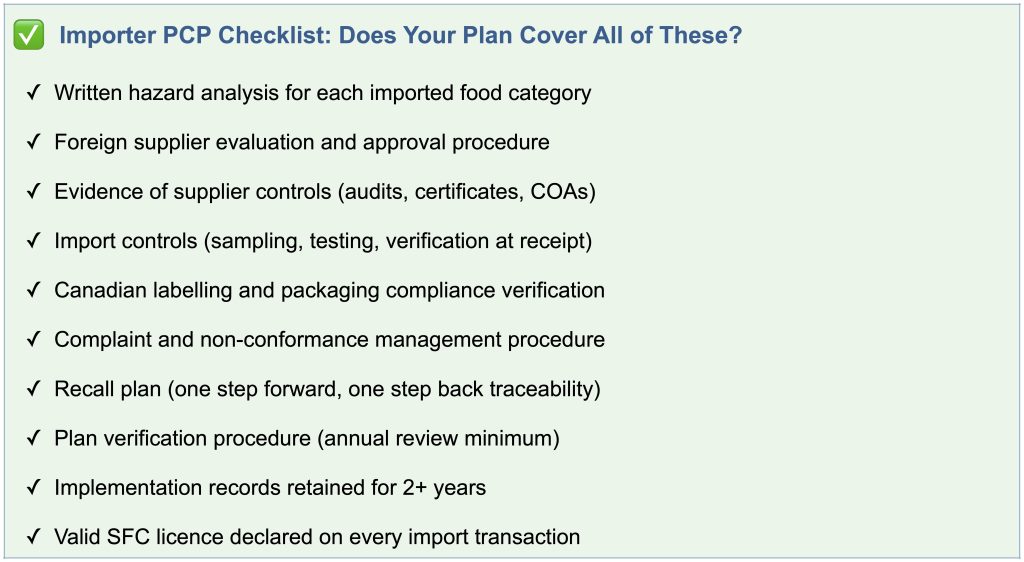
The importer-specific PCP requirements are set out in section 89 of the SFCR. Unlike a domestic manufacturer’s PCP, an importer’s plan focuses primarily on what your foreign suppliers are doing — because you are typically not present at the point of production. The four elements your plan must address are:
1. Hazard Identification and Control Measures
For every food product you import, your PCP must identify the biological, chemical, and physical hazards that could reasonably contaminate that food. This includes both hazards inherent to the food itself (such as Salmonella in spices or aflatoxin in tree nuts) and process-related hazards specific to your supplier’s operations.
Critically, your plan must demonstrate that your foreign supplier has identified and is effectively controlling those same hazards. You are not required to operate the foreign facility — but you are accountable for knowing that controls are in place. Acceptable strategies include:
- On-site audits of your foreign supplier, conducted by you or a qualified third party.
- Third-party certification evidence showing the supplier is in good standing with an internationally recognized certification scheme (e.g., SQF, BRC, FSSC 22000).
- Country recognition arrangements — if the supplier is located in a country that CFIA has recognized as having an equivalent food safety system (such as the United States or EU member states), you may rely on documentation of their regulatory standing.
- Your own supplier evaluation results confirming equivalent Canadian safety standards are met.
2. Foreign Supplier Controls and Procedures
Section 89(4) of the SFCR specifically requires your PCP to describe the procedures you use to evaluate and monitor your foreign suppliers. This is the heart of an importer PCP and goes beyond a simple approved-supplier list. Your plan should document:
- How you select and evaluate new foreign suppliers before the first shipment.
- How frequently you re-evaluate existing suppliers.
- What documentation you collect from suppliers (certificates, audit reports, COAs).
- What you do when a supplier’s standing changes — for example, if their certification lapses or a foreign food safety authority issues a warning.
- Import controls such as product sampling, testing on arrival, or verification testing for high-risk commodities.
Many importers underestimate this section. A list of supplier names and contact information is not a foreign supplier control procedure. CFIA inspectors look for evidence that the evaluation system is active, documented, and product-specific.
3. Consumer Protection: Labelling and Packaging Requirements
Your PCP must include a description of how you ensure the food you import meets Canadian consumer protection requirements — specifically labelling and packaging standards under the SFCR and the Food and Drug Regulations (FDR). This means verifying that imported products meet Canadian bilingual labelling requirements, correct net quantity declarations, accurate ingredient statements, allergen declarations, and applicable grade or identity standards before the food enters the Canadian market.
This section is a common gap in importer PCPs. Many importers focus entirely on food safety hazards and fail to document how they verify that labelling is compliant. During a CFIA inspection, this omission is treated as a plan deficiency.
4. Verification That Your PCP Is Working
Your plan must include a procedure for verifying that the PCP is actually being implemented and is effective. For importers, this typically involves:
- Periodic review of supplier documentation and audit records.
- Review of incoming product test results against specifications.
- Review of customer complaint and non-conformance logs.
- Annual or triggered plan reviews when products, suppliers, or regulations change.
Verification is distinct from monitoring. Monitoring happens in real time (checking a supplier certificate before each shipment); verification is the periodic confirmation that the whole system is functioning as intended.
Record-Keeping: The 2-Year Rule
Under section 89(2) of the SFCR, importers must retain records demonstrating that the PCP has been implemented for a minimum of two years. This includes supplier evaluation records, import documentation, test results, complaint and recall records, and any corrective actions taken.
During a CFIA inspection, the absence of records is treated the same as the absence of controls. Having a well-written PCP on paper but no records showing it was followed is a compliance failure.
How Long Does It Take to Develop an Importer PCP?
A reasonably complex importer PCP — one covering multiple food categories and five to fifteen foreign suppliers — typically takes four to eight weeks to develop properly from scratch. The most time-consuming elements are the product-specific hazard analyses and supplier documentation gathering, particularly if suppliers are based in countries without recognized food safety systems.
Importers who already have internal food safety systems, supplier questionnaires, or existing quality agreements are often able to work more quickly, as much of the underlying documentation already exists and simply needs to be structured into the PCP format.
What Happens If Your Importer PCP Is Deficient?
Under SFCR enforcement, consequences for PCP non-compliance range from written notices and compliance orders to suspension or cancellation of your SFC licence. A suspended licence means your import transactions will be rejected by the IID system until the licence is reinstated — a direct operational disruption to your supply chain.
For importers who have experienced a food safety incident or recall involving an imported product, the adequacy of the importer PCP is central to the regulatory response. Importers who can demonstrate a robust, implemented plan — with records — are in a materially better position than those who cannot.
Working With a Consultant to Develop Your Importer PCP
The CFIA explicitly acknowledges in its importer PCP guidance that food importers may use the expertise of a consultant to develop their plan. Given the complexity of multi-supplier, multi-commodity import operations, professional support can significantly reduce both development time and the risk of compliance gaps.
FTC International has developed Preventive Control Plans for Canadian food importers across a wide range of commodities — from processed foods and specialty ingredients to meat products and natural health product ingredients. Our approach is practical: we build plans that work in the real world of your operation, not just on paper, and that will hold up under a CFIA inspection.
If you’re unsure whether your existing PCP meets current SFCR requirements, or if you’re building one from scratch, contact us for a free 30-minute assessment.
Frequently Asked Questions
Do all Canadian food importers need a Preventive Control Plan?
Most commercial food importers holding a Safe Food for Canadians (SFC) licence are required to maintain a written PCP under Part 4 of the SFCR. Exemptions apply to certain low-risk or small-volume activities. The CFIA’s interactive PCP tool can confirm whether your specific import activity requires a written plan.
What is the difference between an importer PCP and a manufacturer PCP?
A manufacturer’s PCP focuses on the food safety controls applied within the facility — temperature controls, sanitation, CCP monitoring, and so on. An importer’s PCP focuses primarily on foreign supplier assessment and verification, because the importer does not directly control what happens at the production facility overseas. The importer is accountable for ensuring those foreign controls are adequate, and the PCP documents how that assurance is obtained and maintained.
What happens if my SFC licence is not declared at the border?
Since February 2024, import transactions submitted through the CFIA’s Integrated Import Declaration (IID) system are automatically rejected if a valid SFC licence is not declared. Your shipment will be denied entry into Canada until the licensing error is corrected and the import declaration is resubmitted. The licence must be active, issued for ‘Importing Food,’ and cover the specific commodities being imported.
How do I verify that my foreign supplier meets Canadian food safety requirements?
SFCR accepts several approaches: conducting on-site audits of the foreign facility (yourself or through a third party), relying on internationally recognized certification schemes (SQF, BRC, FSSC 22000) if the supplier is in good standing, or sourcing from suppliers in countries that CFIA has recognized as having equivalent food safety systems (such as the US or EU member states). Your PCP must document which approach you use for each supplier and product category.
Does my importer PCP need to cover labelling compliance?
Yes. Your PCP must describe how you ensure that imported food meets Canadian consumer protection requirements, including labelling and packaging standards. This means verifying that products meet bilingual labelling requirements, correct allergen declarations, net quantity declarations, and applicable Canadian grade or identity standards before they enter the Canadian market. Missing this element is a common gap that CFIA inspectors identify during importer inspections.
How long do I need to keep importer PCP records?
Section 89(2) of the SFCR requires importers to retain records showing the PCP has been implemented for a minimum of two years. This includes supplier evaluation records, import documentation, test results, complaint logs, recall records, and corrective action documentation.
How long does it take to develop an importer PCP?
For a typical importer covering multiple product categories and suppliers, expect four to eight weeks to develop a complete, inspection-ready PCP. The timeline depends largely on how many commodities and suppliers are involved, whether those suppliers have internationally recognized certifications, and how much existing documentation (specifications, supplier questionnaires, quality agreements) is already in place.
Can FTC International help me develop or review my importer PCP?
Yes. FTC International has developed Preventive Control Plans for Canadian food importers across a wide range of commodity categories. We offer a free 30-minute initial assessment to evaluate whether your existing plan meets current SFCR requirements, or to scope a new PCP development engagement. Contact us through our website to arrange a consultation.
Does my importer PCP need to be updated when I add new suppliers or new products?
Yes. Your PCP must be kept current and must reflect your actual import operation. Adding a new food category, sourcing from a new supplier, or importing from a new country of origin typically requires a plan update — including a new or updated hazard analysis and supplier evaluation for the new product or source. CFIA expects your PCP to be a living document, not a static file.
What is a non-resident importer and do they need a PCP?
A non-resident importer is a foreign company that imports food into Canada without a physical Canadian business address. Non-resident importers are subject to the same SFC licensing and PCP requirements as Canadian-resident importers. Their SFC licence must be issued specifically for the activity of ‘Importing Food’ — selecting ‘Exporting Food’ is a common error that results in rejected import transactions.
For more information about FTC’s PCP preparation services, click here: